To understand the 10 seconds of Tabata rest, we must understand what fuel is burned in the 20 seconds of work. The predominant energy system in efforts of 0 to 12 seconds of maximum intensity is the phosphagen system (also called ATP-PCr system or allactive system), which uses two substrates directly available in the muscle without the need for oxygen:
Free ATP: There is between 20 and 30 mmol per kilogram of dry muscle weight of ATP stored directly in the muscle fibers. At maximum intensity, this reservoir is depleted in approximately 2-3 seconds. For reference: this ATP represents the energy of approximately 2-3 complete muscle contractions.
Phosphocreatine (PCr): It is the true "fast tank" of the muscle. PCr gives up a phosphate group to ADP to regenerate ATP through the reaction catalyzed by creatine kinase (CK): PCr + ADP → Cr + ATP (ΔG = -43 kJ/mol). This process is so fast that it can maintain ATP production almost as high as free ATP for an additional 6-10 seconds, and at decreasing levels up to 30 seconds.
At 10-15 seconds of a maximum sprint, PCr is practically depleted (15-25% of the total remains). At that point, the anaerobic glycolytic system takes over as the primary source, converting glycogen to lactate and generating H+ in the process. This explains why the feeling of muscle "burning" does not appear in the first 10 seconds but between the 10th second and the 25th second of a maximum sprint.
PCr resynthesis is a process aerobics: requires oxygen to reconstitute the high-energy phosphate bond through mitochondrial oxidative phosphorylation. This process follows first-order exponential kinetics:
PCr(t) = PCr_max × (1 - e-t/τ)
Where τ (tau) is the recovery time constant, which in human skeletal muscle varies between 20 and 35 seconds depending on the level of aerobic training. Athletes with higher VO2 max have shorter tau (higher resynthesis efficiency) because their mitochondria are denser and more active.
For a moderately trained athlete (VO2 max ~50 ml/kg/min, τ = 25s), the 10 seconds of Tabata rest allows a resynthesis of: PCr(10s) = 1 - e^(-10/25) = 1 - 0.67 = 0.33 → 33%.
For a high aerobic athlete (VO2 max ~60 ml/kg/min, τ = 18s): PCr(10s) = 1 - e^(-10/18) = 1 - 0.57 = 0.43 → 43%.
The difference is enormous: the aerobically trained athlete can resynthesize 30% more PCr in the same 10 seconds. This explains why athletes with a higher aerobic base (runners, cyclists who do CrossFit) maintain power in the later Tabata intervals much better than pure strength athletes with lower VO2 max.
The progressive drop in power in the 8 Tabata intervals is a direct consequence of the incomplete resynthesis of PCr in the 10 seconds of rest, not of "lack of will".
Dr. Izumi Tabata published the original protocol in 1996 in the journal Medicine & Science in Sports & Exercise. What most CrossFit and fitness practitioners don't know is the exact context of that study:
- Subjects were speed figure skaters from the Japanese Olympic team, with VO2 max of 60-70 ml/kg/min
- The ergometer used was an electromagnetic resistance bicycle calibrated to produce exactly 170% of each subject's individual VO2 max.
- 170% VO2 max is an intensity that most recreational and semi-professional CrossFit athletes are unable to maintain for even 10 seconds on a calibrated cycle ergometer.
- The vast majority of "Tabatas" that are done in CrossFit pits with burpees, thrusters or bodyweight squats do not reach that 170% of individual VO2 max
Does this mean that "CrossFit" Tabata doesn't work? Not remove. It means that the benefits are real but quantitatively different from those of the laboratory protocol. A kettlebell Tabata swing at an intermediate athlete's maximum perceived effort likely stretches their VO2 max to 140-155%, not 170%. It's still a very effective stimulus, it's just that the claim "just 4 minutes is equivalent to 60 minutes of moderate cardio" is marketing hype.
Since we cannot change the biochemistry, what we can optimize are the conditions that favor the maximum possible resynthesis of PCr in those 10 seconds:
Strategy 1: Recovery Position
The most efficient position to maximize PCr resynthesis in 10 seconds is standing with the trunk leaning forward and hands resting on the knees. This position reduces the hydrostatic demand on the heart (compared to lying on the floor), maintains blood flow to active muscles, and facilitates diaphragmatic ventilation. The lying position on the floor, although it seems "more restful", can slightly delay cardiorespiratory recovery.
Strategy 2: Respiratory Pattern
In the 10 seconds of rest, prioritize complete and forced exhalation followed by a deep diaphragmatic inhalation. Complete exhalation activates the parasympathetic (vagal) system and reduces HR more rapidly than shallow breathing. Do not hyperventilate: rapid, shallow breathing reduces arterial CO2 and can cause peripheral vasoconstriction, reducing blood flow to the muscles that need to resynthesize PCr.
Strategy 3: Exercise Design
The exercises that allow greater resynthesis of PCr in 10 seconds are those that allow a quick transition to a partial rest position. The cycle ergometer is ideal because you can stop pedaling instantly. Thrusts or burpees have a transition component (leaving the bar, getting into position) that consumes 2-3 of the 10 seconds available. Bodyweight squats are the most efficient from this point of view.
The 20:10 is the best known version but not the only one with scientific support. Depending on the specific objective, other proportions may be more effective:
| protocol | Work:Rest Ratio | Duration | Energy System | Aim |
|---|---|---|---|---|
| Original Tabata | 20s:10s (1:0.5) | 4 min (8 rounds) | Phosphagen + Glycolytic | VO2 Max + Lactate Tolerance |
| Little Protocol | 60s:75s (1:1.25) | 20-24 min | Oxidative | General cardiovascular improvement |
| Sprint Intervals | 30s:4:30 (1:9) | 20-25 min | complete phosphagen | Maximum power, top speed |
| EMOM Tabata Hybrid | 20s:40s (1:2) | 10-20 min | Phosphagen + partial oxidative | Power with greater recovery |
| Extended Tabata | 20s:10s × 12 rounds | 6 min | Predominant glycolytic | Advanced lactate tolerance |
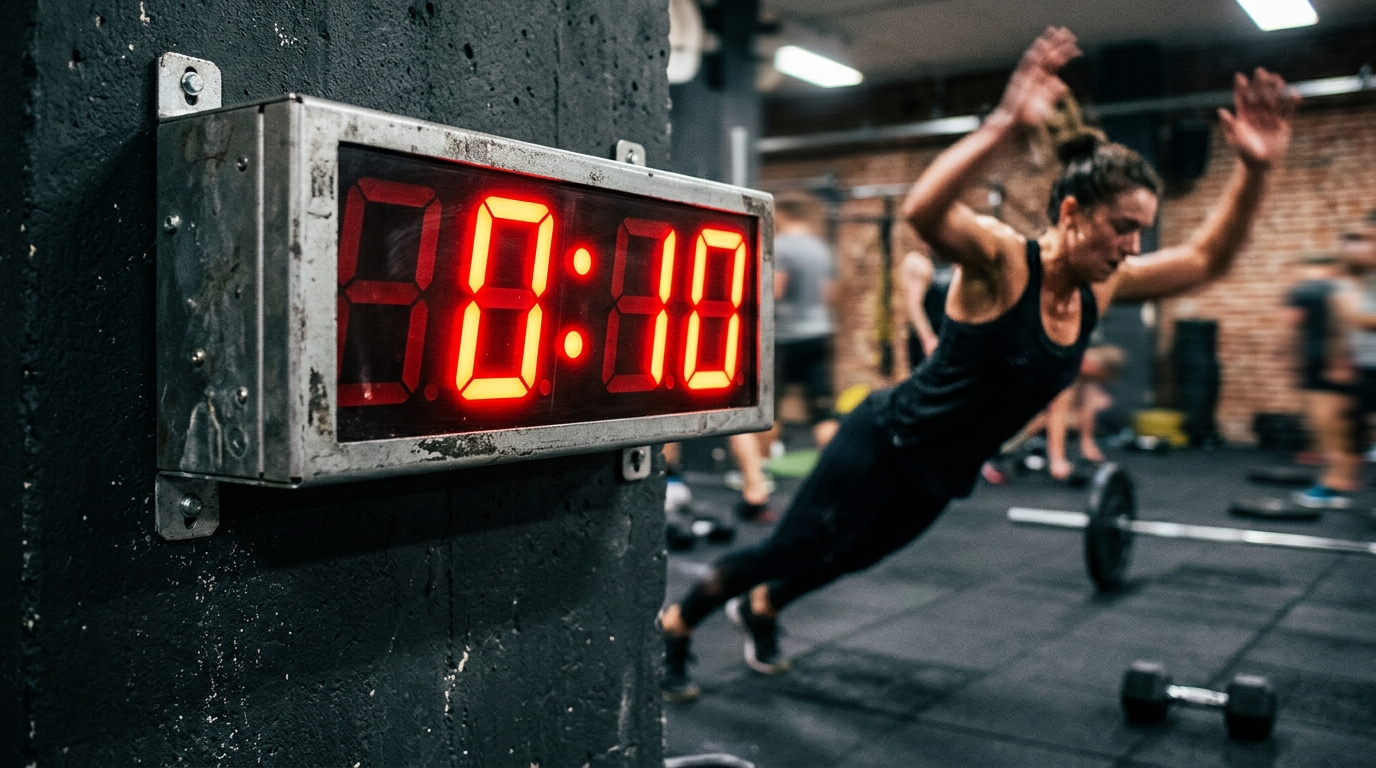
In a protocol where the difference between 10 and 13 seconds of rest represents a 25% variation in recovered PCr, timing error matters. The timers TITAN RX They emit differentiated sound signals at 3, 2 and 1 seconds before the end of the break, and the voice coach announces the number of the completed round so that you do not lose the count while maintaining the breathing pattern. You can set up from 4 to 20 rounds of Tabata, with built-in music that doesn't interrupt the countdown signals.
A lesser known but very valuable application of Tabata is its use as metabolic diagnostic tool. The percentage drop in power (or reps) from the first to the eighth interval is an indicator of the efficiency of the PCr resynthesis system and lactate tolerance.
- drop <20%: High metabolic efficiency. Athlete with a good aerobic base and high lactate buffer capacity.
- Drop 20-35%: Typical performance of a well-trained intermediate CrossFit athlete.
- Drop 35-50%: Deficit in aerobic base or lactate tolerance. It indicates that the adaptations to HIIT are insufficient for the intensity level of the protocol.
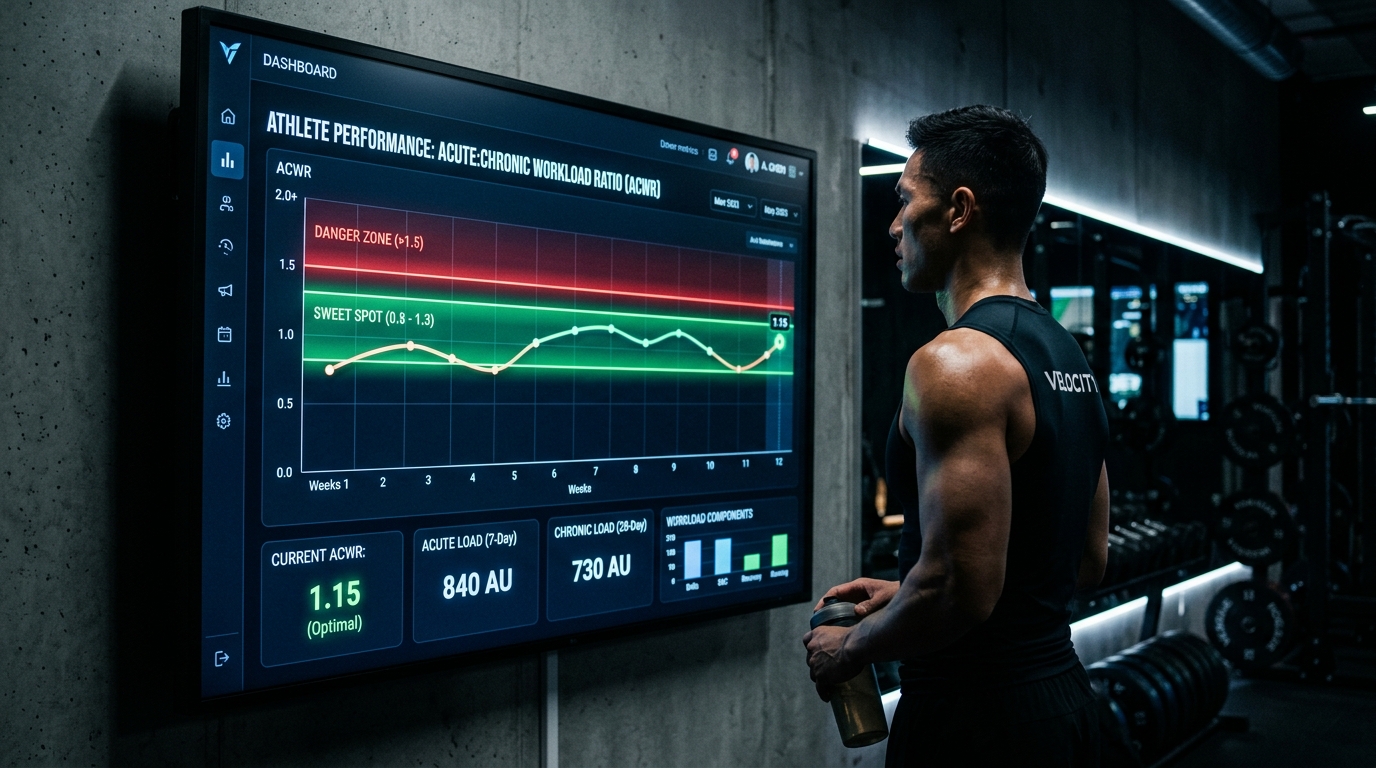
- Drop >50%: The protocol is being executed at an intensity clearly excessive for the athlete's current level, or the training volume for the week has been too high.
Perform a bodyweight squat or cycle ergometer Tabata every 4-6 weeks and record power or reps per interval. The reduction in percentage decline over the months is one of the most sensitive metrics for improving metabolic fitness.