📊
The intuitive concept of injury risk in CrossFit is linear: the more you train, the more you get injured. The reality is considerably more complex and, ironically, more treacherous. The most rigorous epidemiological studies in high-intensity athletes (Blanch & Gabbett, 2016; Gabbett, 2016 in British Journal of Sports Medicine) consistently show that the risk of injury does not increase linearly with the absolute load, but with the sudden variation of that load relative to the history of previous training.
In practical terms: an athlete who has been doing 5 weekly sessions with high load for 3 months can add a 6th session with much lower risk than an athlete who has been doing 3 sessions for 2 months and suddenly decides to do 6. The second athlete does not have the connective tissue, tendon collagen and joint adaptations sufficient to withstand this sudden increase.
What makes this pattern especially treacherous is its temporal aspect: overuse injuries do not appear on the same day as overexertion. Connective tissue (tendons, ligaments, cartilage) has an adaptation time of 3-6 weeks, significantly slower than muscle tissue and the cardiovascular system. An athlete may feel stronger and fitter after 3 weeks of overtraining, with adapted muscle and improved cardio, and yet their patellar tendon or rotator cuff may be accumulating microtrauma that will cause symptoms in weeks 4-6.
The ACWR was conceptualized by researcher Tim Gabbett and his team at the University of Queensland (Australia) as a simple but mathematically rigorous model to quantify the balance between recent training stress (acute) and the ability to absorb that stress built over time (chronic).
The intuition behind the model:
- The chronic load (average of the last 4 weeks) represents the accumulated "fitness" of the athlete: the resistance to training stress that has been built
- The acute load (last week) represents the current "fatigue": the recent training stress to which the musculoskeletal system is exposed
- The ACWR (Acute/Chronic) is the ratio between the two: if it is 1.0, you are training at exactly the same level to which you are adapted. If it's 1.3, you're doing 30% more than your body is prepared to absorb. If it is 0.8, you are training less than your base allows.
"The key is not the amount of training itself, but the relationship between what you are doing now and what your body is used to doing. Fitness is your shield; acute fatigue is your vulnerability."
— Tim Gabbett, PhD, British Journal of Sports Medicine (2016)
Step 1: Quantify Each Session with sRPE
After each WOD, wait 15 to 30 minutes (so that the post-workout euphoria doesn't artificially inflate your perception of effort) and rate the session:
- 1-2: Very light activity (mobility, walking)
- 3-4: Moderate exercise (active warm-up, technique)
- 5-6: Moderate-high effort (moderate volume WOD)
- 7-8: Hard (high intensity WOD, simulated competition)
- 9-10: Maximum effort (1RM test, competition WOD)
Multiply this value by the duration in minutes: sRPE = Intensity × Duration_min
Step 2: Add Acute Load (7 days)
Example of a double session week:
| Day | Session 1 | sRPE 1 | Session 2 | sRPE 2 | Total AU |
|---|---|---|---|---|---|
| Monday | WOD 45min RPE 8 | 360 | Strength 30min RPE 7 | 210 | 570 |
| Tuesday | Mobility 20min RPE 3 | 60 | — | 0 | 60 |
| Wednesday | WOD 50min RPE 9 | 450 | Run 20min RPE 6 | 120 | 570 |
| Thursday | Active rest 30min RPE 2 | 60 | — | 0 | 60 |
| Friday | WOD 45min RPE 8 | 360 | — | 0 | 360 |
| Saturday | WOD 60min RPE 8 | 480 | — | 0 | 480 |
| Sunday | Rest | 0 | — | 0 | 0 |
| Total acute charge | 2,100 AU | ||||
Step 3: Calculate the Chronic Load (average of the last 4 weeks)
If your loads for the last 4 weeks were: 1,400 AU, 1,600 AU, 1,800 AU, and 2,100 AU (this week), the chronic load is (1,400+1,600+1,800+2,100)/4 = 1,725 AU.
ACWR = 2.100 / 1.725 = 1.22. You are in the sweet spot (0.8-1.3). Good.

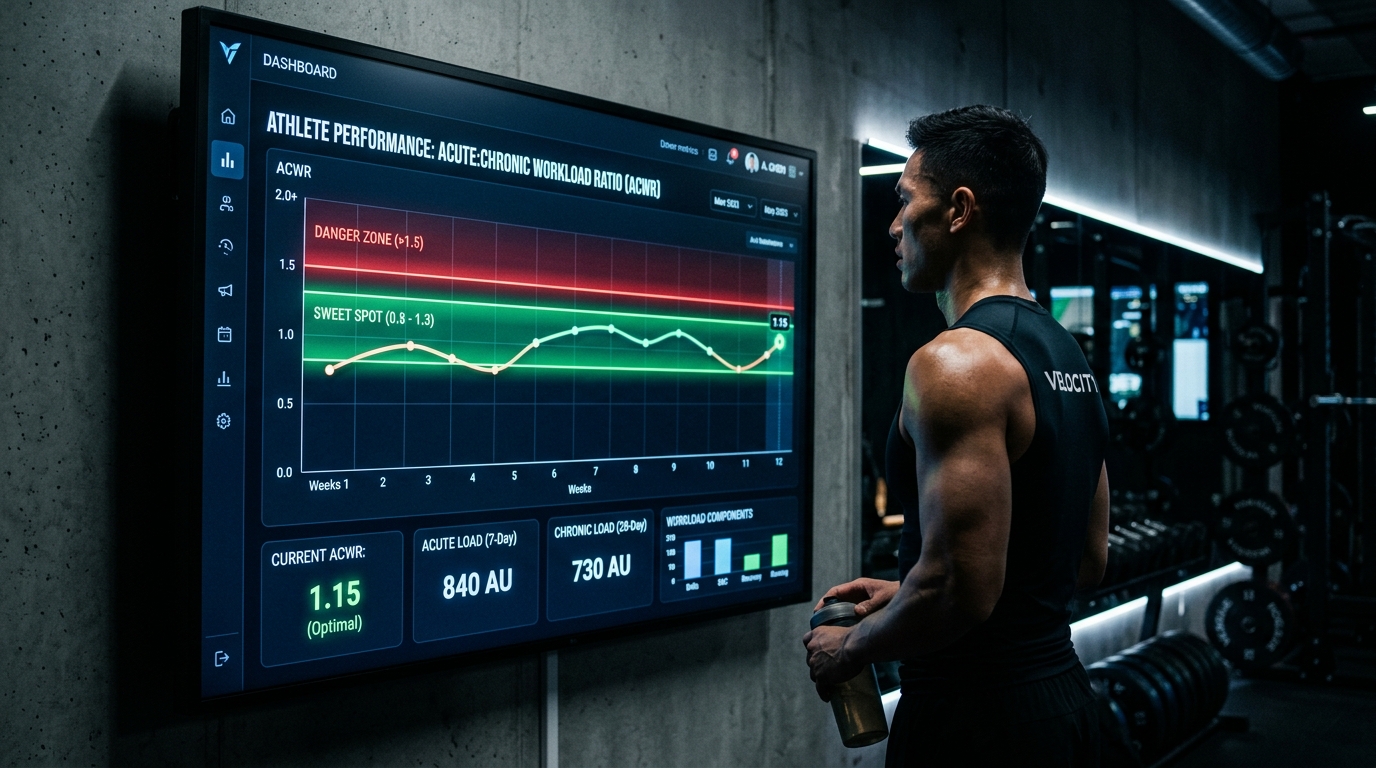
The ACWR model visualized: the green zone (0.8-1.3) is the space where the training stimulus is sufficient to generate adaptations without exceeding the recovery capacity of the connective tissue.
The ACWR calculated with simple moving averages (Rolling Average) has an important flaw: it gives the same statistical weight to what you trained 4 weeks ago as to what you trained yesterday. The EWMA (Exponentially Weighted Moving Average) model corrects this problem by giving decreasing weights to the oldest data: today's session has more weight than yesterday's, which has more than the day before yesterday, and so on.
The simplified EWMA formula for acute (λ = 0.28, approximately 7 days) and chronic (λ = 0.1, approximately 28 days) loading:
Acute_EWMA(today) = λ × sRPE(today) + (1 - λ) × acute_EWMA(yesterday)
EWMA_chronic(today) = λ_chronic × sRPE(today) + (1 - λ_chronic) × EWMA_chronic(yesterday)
The EWMA model is used by the most advanced load monitoring systems (such as those used by professional football clubs and elite athletics teams). For individual CrossFit athletes, weekly updated simple averaging is sufficiently accurate if applied consistently.
🟢 ACWR 0.8-1.0 (Development Zone)
Slightly below the optimal load. Good window to safely add volume or intensity. Don't interpret this as "I'm not training enough": it's the adaptation consolidation zone.
✅ ACWR 1.0-1.3 (Optimal Zone)
The sweet spot. You are generating enough training stimulus for continuous adaptations within the tissue's recovery capacity. Maintain this range during competition preparation periods.
⚠️ ACWR 1.3-1.5 (Caution Zone)
Increased supervision. You can be here briefly (1-2 weeks) if you have a specific goal, but you should actively reduce the load the following week. Prioritize sleep and nutrition.
🔴 ACWR >1.5 (Danger Zone)
Reduces the load immediately. The risk of overuse injury is doubled. Athletes who systematically ignore this threshold account for 80% of chronic tendon and joint injuries in CrossFit.
TITAN RX as a Load Monitoring Tool
The TITAN RX workout history records the duration of each completed session. By combining that data with your perceived exertion noted in your session notes, you can manually calculate your weekly sRPE and keep your ACWR in the green zone. Many athletes who start tracking find that their "good training weeks" were actually weeks of ACWR >1.5 that invariably preceded minor joint or muscle discomfort.
🟢 ACWR 0.8-1.0 (Development Zone)
Slightly below the optimal load. Good window to safely add volume or intensity. Don't interpret this as "I'm not training enough": it's the adaptation consolidation zone.
✅ ACWR 1.0-1.3 (Optimal Zone)
The sweet spot. You are generating enough training stimulus for continuous adaptations within the tissue's recovery capacity. Maintain this range during competition preparation periods.
⚠️ ACWR 1.3-1.5 (Caution Zone)
Increased supervision. You can be here briefly (1-2 weeks) if you have a specific goal, but you should actively reduce the load the following week. Prioritize sleep and nutrition.
🔴 ACWR >1.5 (Danger Zone)
Reduces the load immediately. The risk of overuse injury is doubled. Athletes who systematically ignore this threshold account for 80% of chronic tendon and joint injuries in CrossFit.
The TITAN RX workout history records the duration of each completed session. By combining that data with your perceived exertion noted in your session notes, you can manually calculate your weekly sRPE and keep your ACWR in the green zone. Many athletes who start tracking find that their "good training weeks" were actually weeks of ACWR >1.5 that invariably preceded minor joint or muscle discomfort.