To understand HRV, we must first understand how the autonomic nervous system (ANS) regulates heart rate. The ANS has two main branches that act as the body's accelerator and brake:
Sympathetic Nervous System (SNS): The "mode of action." Release of norepinephrine and epinephrine, increase in HR, redistribution of blood flow to the muscles, inhibition of the digestive and reproductive system. Active during exercise, stressful situations, lack of sleep and periods of high training load.
Parasympathetic Nervous System (PNS): The "recovery mode". Release of acetylcholine, reduction of HR, activation of the digestive and immune system, protein synthesis, production of growth hormone (which occurs mainly during deep sleep). Dominant at rest, sleep, recovery and periods of low load.
The key is that both branches "fight" for control of the cardiac pacemaker (the SA node), and this "fight" produces fluctuations in the time between consecutive beats. High beat-to-beat variability (high HRV) indicates that the parasympathetic is active and can flexibly modulate HR. Low variability (low HRV) indicates that the sympathetic is dominant and HR tends to be more rigid and uniform.
There are multiple metrics derived from cardiac variability records (RR intervals), but the rMSSD (Root Mean Square of Successive Differences) is the most used in sports research and the most sensitive to acute changes in sympathetic-parasympathetic balance.
Its formula: rMSSD = √(1/n × σ(rr_{i+1} - rr_i)²)
In practical terms, the rMSSD measures the average magnitude of the differences between consecutive heartbeats. If your heart beats at 60bpm with intervals of 960ms, 1040ms, 980ms, 1020ms... The difference between them (80ms, 60ms, 40ms...) is the data that the rMSSD processes. Greater variation between consecutive beats (high rMSSD) indicates better parasympathetic tone and greater recovery.
Why rMSSD and Not SDNN or Other HRV Metrics?
The SDNN (standard deviation of all RR intervals) reflects both sympathetic and parasympathetic activity and responds to circadian rhythms, making it more sensitive to postural and measurement schedule variations. The rMSSD is more specifically sensitive to vagal (parasympathetic) tone and more stable against measurement artifacts, making it ideal for short (3-5 minute) morning measurements.
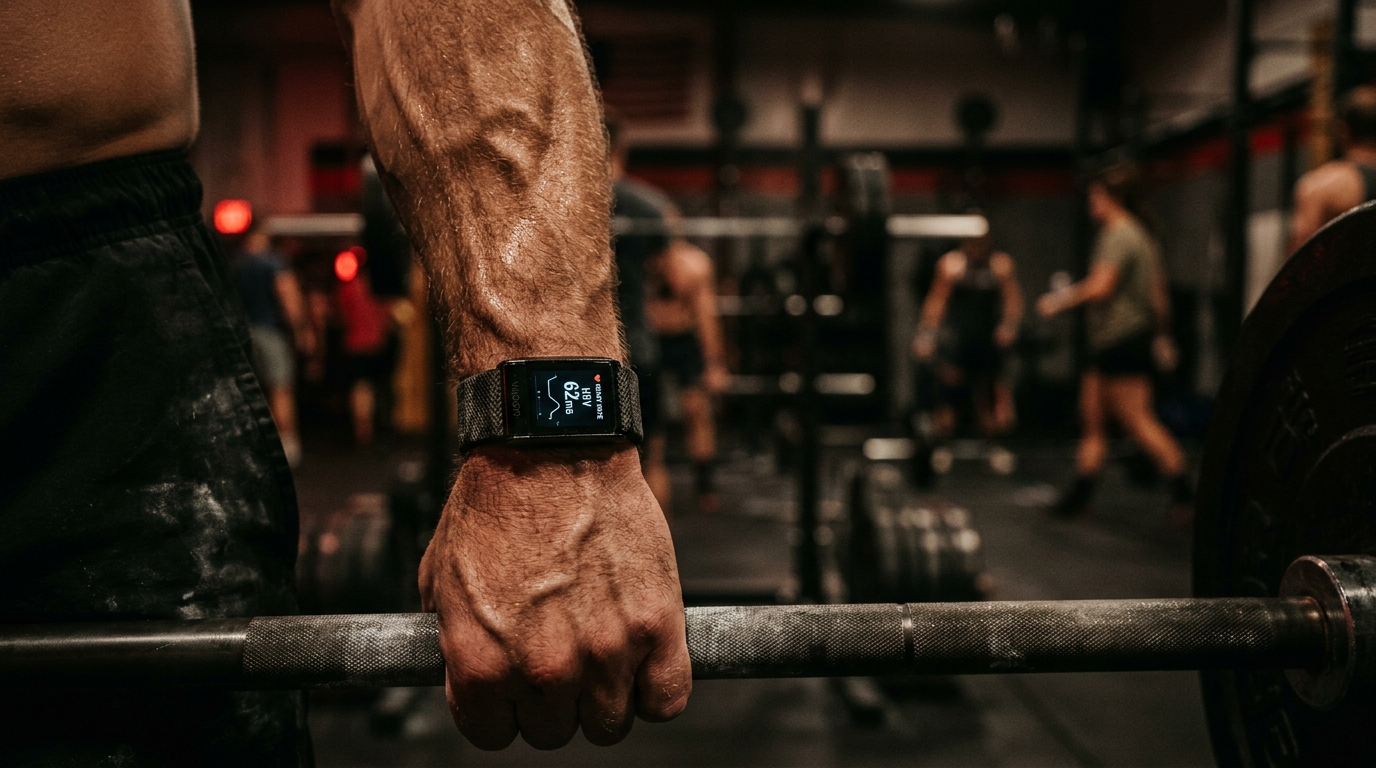
The HRV trend in weeks and months (not the isolated daily value) is the predictive data of the athlete's state of adaptation and recovery.
Necessary Equipment
There are two main measurement methods:
- Chest band (ECG): The most precise. A heart rate band (Polar H10, Garmin HRM-Pro, Wahoo TICKR It is the gold standard for serious athletes.
- Wrist Wearable (PPG): Smart watches and rings (Apple Watch Series 8+, Garmin Epix, OURA Ring) use photoplethysmography (PPG) to estimate RR intervals. Accuracy is lower than band ECG (±5-10%), but sufficient for long-term trends. Avoid PPG wearables for critical individual measurements (a day with poor signal may raise a false alarm).
Standardized Morning Measurement Protocol
- When you wake up, before getting out of bed and before looking at your phone, drinking coffee or eating
- Supine position (lying on back), normal breathing, eyes closed
- Duration: minimum 3 minutes, ideal 5 minutes
- Same time every day (±15 minutes maximum variation)
- Avoid the day after a night of alcohol: alcohol artificially suppresses HRV for the next 24-36 hours and contaminates the baseline
- During the baseline period (first 3 weeks), measure even on rest or low-intensity days
Once you have your baseline established (average rMSSD of the last 7 days), you can use the day's value as a signal to make intensity decisions:
| rMSSD Status | Interpretation | Training Decision | Alert Color |
|---|---|---|---|
| rMSSD ≥ Baseline (+5% or more) | Excellent recovery, dominant SNP | Complete WOD + possible planned intensification | 🟢Green |
| rMSSD between -5% and +5% of LB | Normal recovery state | Complete WOD according to established program | 🟢Green |
| rMSSD between -5% and -15% of LB | Partial recovery, SNS on | Reduce intensity to 80% of the plan. More warming up. | 🟡Yellow |
| rMSSD between -15% and -25% of LB | Insufficient recovery | Technical or mobility work only. RPE <6. | 🟠Orange |
| rMSSD < -25% of LB | Significant ANS stress | Active passive rest. Investigate cause. Not WOD. | 🔴 Network |
A common mistake is to interpret each drop in rMSSD as a sign of overtraining. HRV is a metric of the state of the autonomic nervous system as a whole, not just physical training. These non-exercise factors can significantly reduce rMSSD:
- High work or emotional stress: Chronic cortisol activates the SNS and suppresses the PNS during periods of high psychosocial stress
- Alcohol: A single glass of wine reduces the next day's morning rMSSD by 5% to 15%. Two or more drinks can suppress HRV 48-72 hours
- Incipient disease: HRV drops 1 to 3 days before the first symptoms of a viral infection (cold, flu) appear, making it an early indicator of health
- Extreme heat during sleep: High ambient temperature during sleep reduces deep sleep quality and, consequently, morning HRV
- Menstrual cycle: In female athletes, rMSSD is consistently lower in the luteal phase than in the follicular phase, regardless of training
The most profound utility of HRV monitoring is not in the daily value, but in trends over weeks and months. An athlete who is steadily improving their fitness will see a slow but steady upward trend in their base rMSSD over the months.
This trend reflects real adaptations of the nervous system: greater density of cholinergic receptors in the myocardium, greater vagal tone at rest, greater mitochondrial efficiency in cardiac cells. It is the same reason why elite endurance athletes have resting HRs of 38-50 bpm and rMSSD of 80-150 ms, compared to 60-70 bpm and 30-60 ms for the sedentary population.
When HRV indicates reducing intensity, you don't have to abandon the workout: select a mobility or Zone 2 WOD from the workout library. TITAN RX, set the smooth running timer with target HR prompts, or work on barbell technique with the voice coach without time pressure. The library of more than 6,500 WODs includes filters by intensity (Low / Medium / High / Maximum) that allow you to select the appropriate stimulus for any day, be it green, yellow or red.