The Olympic bar market is littered with technical specifications that sound impressive but without proper context are completely opaque to the buyer. "PSI 190,000", "4340 steel", "bright zinc plated", "knurling IPF" - what do each of these terms really mean and which ones matter to a CrossFit athlete?
Tensile Strength (PSI): The Most Important Number
Tensile Strength is the maximum force per unit area that a material can withstand before fracturing. It is measured in PSI (pounds per square inch) or MPa (Megapascals). To convert: 1 PSI ≈ 0.00689 MPa. Thus, 190,000 PSI ≈ 1,310 MPa.
Why does this number matter for CrossFit specifically? In Olympic lifts (Snatch, Clean & Jerk), the bar experiences a very different load-unload cycle than powerlifting lifts. When you release the bar from the overhead squat position and the bumpers hit the ground, the bar experiences a sudden impact. If the bar material has a low Tensile Strength, this repeated impact can cause micro-fatigue of the steel that eventually results in fracture or permanent deformation (bend).
Yield Strength vs. Tensile Strength: The Difference No One Explains
The most common confusion is between Tensile Strength and Yield Strength. Tensile Strength is the fracture limit. I have Yield Strength is the limit of permanent deformation: the maximum stress to which the material can be subjected and still recover its original shape when the load is removed.
At 190,000 PSI Tensile Strength but 120,000 PSI Yield Strength bar will not fracture under extreme loads of 150-200kg, but yes it will bend permanently with repeated moderate impacts because the Yield Strength is below the tension generated by those impacts. The optimal Yield/Tensile ratio for an Olympic bar is for the Yield to be at least 75-80% of the Tensile.
Types of Steel: Why Grade Number Matters
Quality bars use alloy steels that incorporate elements such as chromium (Cr), molybdenum (Mo), manganese (Mn) or nickel (Ni) to improve resistance without sacrificing the elasticity (whip) that makes a high-end Olympic bar so recognizable:
- 1045/1060 steel (medium carbon): The entry and mid-range bars. PSI 150,000-180,000. Enough for recreational use.
- 4340 steel (chromium-nickel-molybdenum): High performance bars. PSI 185,000-210,000. Greater resistance to fatigue and better dynamic "whip".
- 4140 steel (chrome-molybdenum): Intermediate commitment. PSI 170,000-195,000. Very good quality/price ratio in the medium-high range.
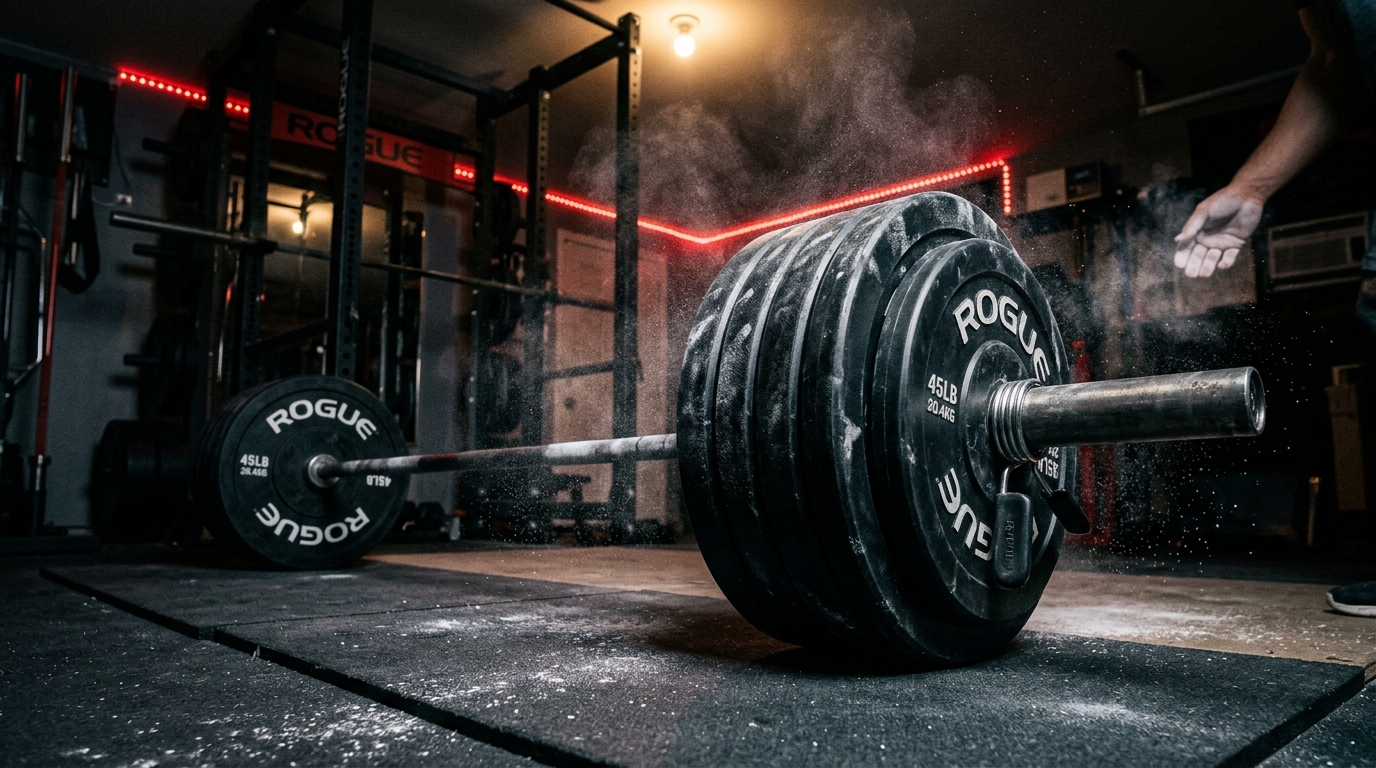
A well-equipped 15-20m² functional CrossFit home gym surpasses many commercial ones that lack specific functional equipment in training effectiveness.
The knuckle is the part of the bar where the discs are placed and which must rotate with respect to the central axis (the bar itself). This turn is critical in Olympic lifts: when the weight goes up in the Snatch or Clean, the bar needs to rotate on its axis so as not to transmit torque from the athlete's wrist to their joints.
Needle Bearings
Needle bearings consist of multiple very thin cylindrical rollers (the "needle") arranged in a circle within the spindle. They allow a smoother rotation, with less resistance (less rolling friction), faster and with a lower rotation start threshold (you don't need as much initial force for the spindle to start rotating).
They are ideal for the Snatch and Clean because the bar needs to rotate very quickly at the moment of the pull. They are more delicate and sensitive to chalk dust (chalk gets into the housings and wears out the needles) and require periodic maintenance (lubrication with light bearing oil every 3-6 months depending on use).
Bronze Bushings
The bushing is a metal cylinder (usually phosphor bronze alloy or brass) that acts as a sliding surface between the axle and the knuckle. They have more resistance at the beginning of rotation (greater static friction), but once in motion, they offer a solid and very durable rotation.
They are significantly more durable than needle bearings in high repetition, chalk dust and heavy use environments. A quality brass bushing can maintain its performance for 8-15 years with heavy use and basic maintenance (a few drops of oil on the retaining rings every 3 months).
| Features | Needle Bearings | Bronze Bushings |
|---|---|---|
| Rotation smoothness | ⭐⭐⭐⭐⭐ | ⭐⭐⭐⭐ |
| rotation speed | very high | Medium-high |
| Durability (high use) | ⭐⭐⭐ | ⭐⭐⭐⭐⭐ |
| Chalk dust tolerance | Low (requires frequent cleaning) | High |
| Maintenance | Every 3-4 months | Every 4-6 months |
| best for | Technical weightlifting, competition | CrossFit, HIIT, high volume |
| Price (full bar) | 400-900€ | 200-500€ |
Bumper plates are rubber or vulcanized rubber discs designed to absorb the impact of falls in Olympic lifts. Unlike conventional iron discs, the bumpers have the same outer diameter (450mm) regardless of weight, which ensures that the bar is always at the same height from the ground for the next grip.
The Shore A Scale: The Most Important Parameter in Bumpers
The Shore A scale measures the hardness of a material with a durometer using a metal cone under standard loading (ASTM D2240). For CrossFit bumper plates, the optimal range is 88-92 Shore A:
- Shore A < 80: Too soft. The disc will permanently deform over time, develop unpredictable bounce, and may "grow" laterally reducing its load capacity. Cheap low quality import records.
- Shore A 80-87: Commitment zone. Acceptable for recreational use but with reduced shelf life in intensive use environments (>50 drops per session).
- Shore A 88-92: Optimal for CrossFit. Good impact absorption, controlled rebound, high durability. Mid-high range discs like Eleiko, Rogue Fitness or Get RX'd.
- Shore A > 93: Too hard. It transmits excess impact to the ground (dangerous for forged) and to the athlete's joint system. Technical competition plates (calibrated steel bumpers) are at this extreme and are not suitable for general CrossFit use.
Types of Bumper Plates by Material
Vulcanized Virgin Rubber (Virgin Rubber)
Virgin rubber produces bumpers with better surface texture, lower odor (critical in closed spaces), more Shore A consistency and greater dimensional stability. They are preferred for competition facilities and high-level commercial pits. They are also the most expensive.
Crumb Rubber (Pressed Recycled Rubber)
Crumb rubber bumpers are made by pressing recycled rubber chips (usually from tires) into high-pressure molds. They are more affordable, very durable, with good impact absorption but with greater Shore A variability between batches and a more intense odor. They are the most popular option in mid-price boxes and home gyms.
The floor is the most underrated component of a home gym. I have seen athletes spend €800 on a bar and €600 on bumpers placed on a single layer of 10mm pool rubber. The first Snatch above 80kg with this configuration leaves a permanent mark on the floor and can, in buildings of lower structural resistance, transmit a vertical impact of 3-5 kN to the floor.
The Optimal Floor System for Olympic Lifts at Home
- Base layer: 22mm thick birch plywood boards. The plywood distributes the impact over a larger area and acts as a low-frequency damper.
- Middle layer: Recycled rubber slabs 15-20mm thick and minimum density of 90 kg/m³ (not the EVA foam of aerobic fitness).
- Surface layer (optional for uplift areas): An 18mm pine or maple wood platform on the rubber to create the firm surface where the lifts are performed.
The biggest challenge of the home gym is not the equipment: it is the programming. Without a coach to guide you and without the social pressure of boxing, motivation and variety suffer after a few weeks. TITAN RX solves this problem with a filter of WODs by available material: if you only have a barbell and bumpers, you access the WODs designed exactly for that configuration, including 4, 8 and 12 week periodization cycles with automatic load progression.