Ecdysterone, or 20-Hydroxyecdysone (20E), is a phytoecdysteroid produced naturally by various plants such as Spinacia oleracea (yes, the spinach of a lifetime), the Cyanotis vaga and the Turkestan Ajuga. Historically, phytoecdysteroids are the molting hormones of arthropod insects, but in mammals they act through a completely different mechanism than classical androgens.
The crux of the matter is in the receptor: 20E does not bind to the androgen receptors (AR), which is the point of action of anabolic-androgenic steroids. Instead, its anabolic activity appears to mediate through estrogen receptor beta (ERβ), which activates the mTORC1 (mammalian target of rapamycin complex 1) pathway, the master switch of muscle protein synthesis in response to strength training. All this without suppressing the hypothalamic-pituitary-gonadal (HPG) hormonal axis or producing the side effects associated with anabolic androgenic drugs.
The most cited study in recent literature is that of Isenmann et al. (2019), published in the Journal of the International Society of Sports Nutrition, where 46 trained subjects (ages 20-30, with at least 2 years of strength training experience) followed a 10-week hypertrophy protocol. The group that supplemented with 200 mg of ecdysterone daily obtained an increase in lean muscle mass of 11%, compared to 5% in the placebo group. Bench press strength increased 19.4% vs. 8.3% in the placebo.
Why the Mechanism of Action Matters More than the Result?
The reason why the mechanism is so relevant is practical: if 20E acts via ERβ and not via AR, it can be combined with other compounds without the risk of saturating the androgen receptor (which occurs when multiple androgenic compounds are combined). This opens the door to layered supplementation—ecdysterone + creatine + beta-alanine—in which each acts through a different metabolic pathway without interference between them.
Ecdysterone Use Protocol for CrossFit Athletes
- Dosage: 200-500mg/day of 95% standardized extract of 20-Hydroxyecdysone
- Timing: With the highest calorie meal of the day to improve absorption with lipids
- Recommended cycle: 8-12 weeks on, 4 weeks off
- Shape: Extract from Cyanotis vaga o Turkestan Ajuga preferable to standard spinach due to higher concentration of 20E
- Optimal combination: Along with post-workout whey protein to take advantage of the post-exercise anabolic state
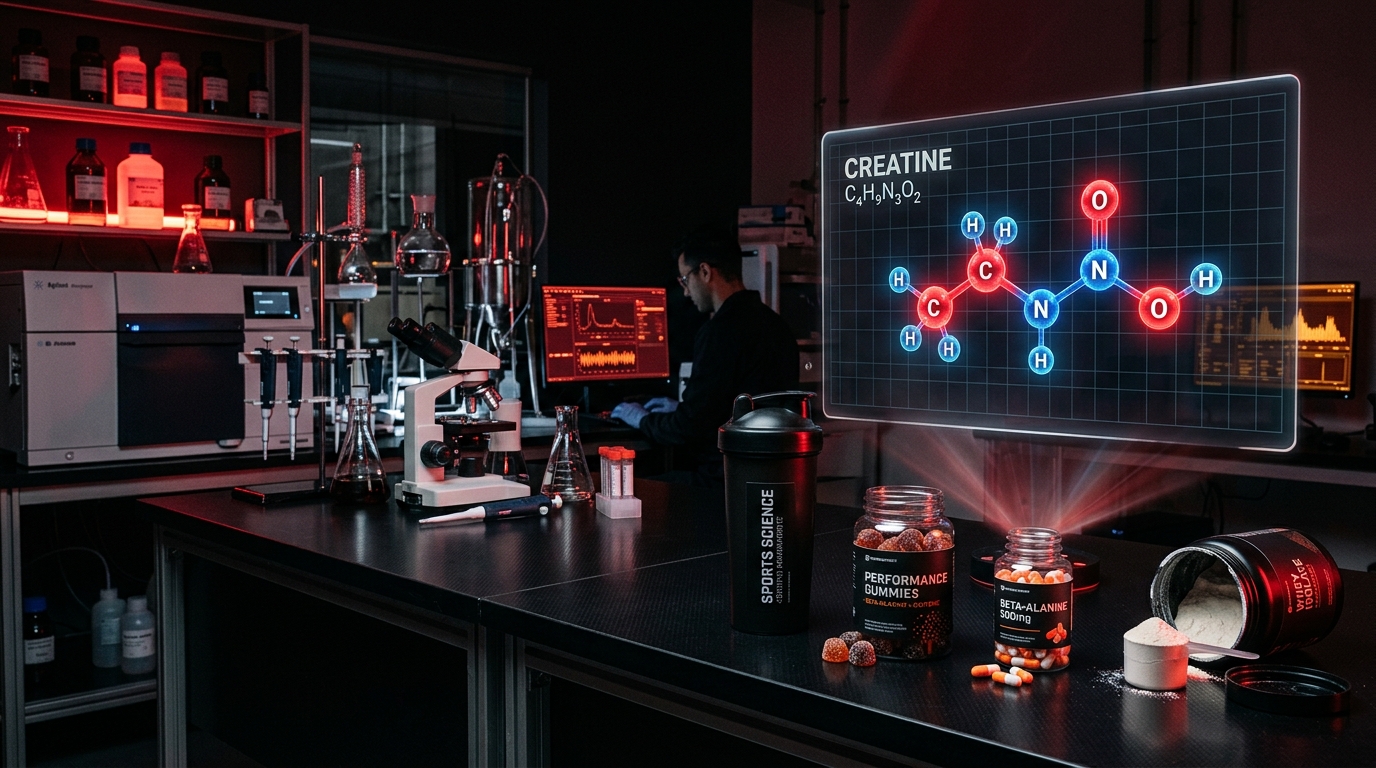
The layered supplementation strategy combines compounds with different mechanisms of action, maximizing benefits without redundancies or negative interactions.
If there is one supplement designed specifically for the CrossFit style of training, it is beta-alanine. To understand why, we need to talk about what really kills your reps in the later rounds of a Fran, an Isabel, or any high-intensity 8-15 minute WOD.
The popular culprit is "lactic acid", but the biochemical reality is more precise: the real person responsible for muscle failure in efforts of 30 seconds to 4 minutes is hydrogen ions (H+), obligatory byproduct of anaerobic glycolysis. These ions reduce intramuscular pH (from 7.0 to values of 6.5-6.3), inhibiting the activity of myosin ATPase (the enzyme that feeds myofibrils) and causing the characteristic sensation of burning, heaviness and sudden muscle failure.
The carnosine (beta-alanyl-L-histidine) is the most abundant pH-buffering dipeptide in human skeletal muscle, capable of capturing and neutralizing H+ ions thanks to its imidazole group. The problem is that carnosine is not absorbed directly from the intestine; The body synthesizes it internally from two precursor amino acids: histidine (usually available in sufficient quantity) and beta-alanine, which is the limiting factor of this synthesis.
How Much Does Real Performance Change?
The most rigorous meta-analyses (Hobson et al., 2012; Saunders et al., 2017) show an effect size (ES) of between 0.18 and 0.37 in exercises lasting 60-240 seconds. To put it into practical perspective: in a 3-minute WOD (a "Nancy" or a "Jackie"), an ES = 0.25 improvement is roughly equivalent to 4-7 seconds improvement in total time. Small in absolute terms, but significant in the competitive context where the differences between athletes are measured in seconds.
| Creatine Type | Bioavailability | Solubility | Cost per 5g | Best For |
|---|---|---|---|---|
| Monohydrate (Creapure) | ⭐⭐⭐⭐⭐ | Average | ~0.15€ | Maximum strength, quality/price ratio |
| Gummies | ⭐⭐⭐⭐ | High (already dissolved) | ~0.90€ | Portability, protocol adherence |
| Hydrochloride (HCl) | ⭐⭐⭐⭐ | very high | ~0.45€ | Gastrointestinal intolerance to monkey |
| Micronized | ⭐⭐⭐⭐⭐ | High | ~0.20€ | Fast mixing, slightly improved absorption |
| Kre-Alkalyn | ⭐⭐⭐ | High | ~€0.55 | pH stabilized (weak scientific evidence) |
Creatine gummies burst onto the market between 2022 and 2023 as a "fun" alternative to traditional powder. The legitimate question is: what happens to creatine during the cooking process needed to make gummies?
The potential problem is in the hydrolysis of creatine to creatinine, its inactive metabolite. This process accelerates exponentially with low temperature and pH. Gummies are manufactured at temperatures of 80-120°C and their acidic taste means a low pH, two factors that create a potentially hostile environment for creatine.
How to Identify Quality Creatine Gummies
- Microencapsulated creatine: The manufacturer encapsulates the creatine before adding citric acid, avoiding direct contact
- Certificate of Analysis (CoA): Requires a CoA with HPLC analysis showing creatine purity >99% in the finished product (not the raw material)
- Creapure Seal: Creapure sourced creatine (AlzChem, Germany) has the highest documented purity and independent verification protocols
- Storage temperature: Avoid gummies stored in hot places (>28°C) as degradation continues after manufacturing
- Expiration date: Creatine gummies have a shorter shelf life than powder. Prefer products with at least 12 months of expiration.
Combined Supplementation Protocols for High Performance
This is where supplementation stops being about "taking things" and becomes a system designed to maximize energy resynthesis, pH buffering and protein synthesis, each in its optimal time window:
- CREATINE (days 1-7, load): 20g/day divided into 4 doses of 5g with carbohydrates
- CREATINE (day 8 onwards, maintenance): 5g post-workout with protein shake + fruit
- Beta-alanine: 4 × 1.6g/day with meals for 6 weeks. Reduction to 3.2g/day in maintenance
- Ecdysterone: 200-400mg/day with the highest calorie meal of the day for 10-12 weeks
- Cycling: Creatine: continuous use possible. Beta-alanine: 6 weeks active / 2 weeks off. Ecdysterone: 10-12 weeks active / 4 weeks off
Real Limits and the 95/5 Rule in Sports Nutrition
It is essential to close this analysis with an honest perspective: even the supplements with the most scientific evidence (creatine, beta-alanine, caffeine) offer performance improvements of between 2% and 8% under optimal conditions. This is relevant and worth optimizing, but it does not transform an intermediate athlete into an elite competitor.
The variables that have a tenfold impact on performance are: sleep quality and quantity (between 7 and 9 hours for active adults), chronic stress management (chronically elevated cortisol suppresses protein synthesis and muscle recovery), training periodization (ordered progression is more powerful than any supplement), and total caloric intake (no supplement compensates for a severe caloric deficit during periods of high training load).
Supplements are 2-5% of the performance equation. But when everything else is optimized, that 2-5% can be exactly the difference that separates you from the podium.
Session history TITAN RX allows you to correlate your wellness and nutrition notes with actual performance in each WOD. Many athletes who start using the app discover that the worst days on the ergometer or in strength movements consistently coincide with nights of less than 6.5 hours of sleep, regardless of the supplementation used.
Interactions and Synergies between Supplements
Not all supplement combinations are neutral. Some can reduce the effectiveness of others or generate competition for the same membrane transporters:
- Creatine + Caffeine: Historically controversial. The most recent studies do not show a significant negative interaction with caffeine doses lower than 5mg/kg. The initial concern (caffeine-induced dehydration affecting creatine retention) has not been confirmed under conditions of normal hydration.
- Beta-Alanine + Taurine: They compete for the same TAUT amino acid transporter in muscle. If you take both simultaneously, they can reduce each other's absorption. Separate them at least 2 hours.
- Ecdysterone + Whey Protein: Documented synergistic combination. 20E activates mTORC1, and whey protein provides the essential amino acids necessary for the protein synthesis that mTORC1 accelerates. Take them together post-workout.
- Creatine + High GI Carbs: Positive synergy. The insulin spike caused by simple carbohydrates (dextrose, maltodextrin) increases muscle uptake of creatine through the insulin-sensitive transporter SNAT2.