Before talking about technique, we need to understand basic physics. The Sled Pull at HYROX is performed on a short fiber synthetic carpet. The force you need to apply to move the sled is determined by the kinetic friction between the sled runners and the carpet, modified by the angle of pull of the rope.
The kinetic friction force is: F_friction = μ_k × N, where μ_k is the coefficient of kinetic friction of HYROX carpet (typically between 0.35 and 0.45 depending on the surface condition) and N is the normal force (the weight of the sled minus the vertical component of your traction). The latter is key: if you pull up at a 35° angle, you are reducing the vertical component of the load on the carpet and therefore reducing the friction you must overcome.
Complete formula for the minimum tensile force:
F_optimal_traction = μ_k × (Sled_weight × cos(θ)) / (cos(θ) + μ_k × sin(θ))
For a 153 kg sled on HYROX carpet (μ_k = 0.40) and an angle of 35°, the optimal tractive force results in approximately 480 Newtons or 48.9 kgf. At a 0° angle (horizontal), the force required would be 612 Newtons. That is, the correct angle saves you 22% of force per repetition.
The static coefficient of friction (when the sled is stationary) is systematically greater than the kinetic one (when it is already moving). In HYROX carpet, this difference can be 15-25%. This means that the first 30-50 centimeters of each 12.5m section are the most demanding in terms of force required.
The practical implication: Don't start the sled with an explosive first pull of your arms. The arms will fail before the sled moves. Instead, use the following steps:
- Position your body with the rope taut but without maximum tension
- Lower the center of gravity (hip and knee flexion)
- Apply gradual force in the first 0.5 seconds
- When the sled begins to move, quickly transition to the step rhythm
Athletes who perform the first pull as if they were doing a power row in the gym expend between 30% and 40% more energy in the first five feet, and that energy deficit accumulates during the 4 repetitions of the station.
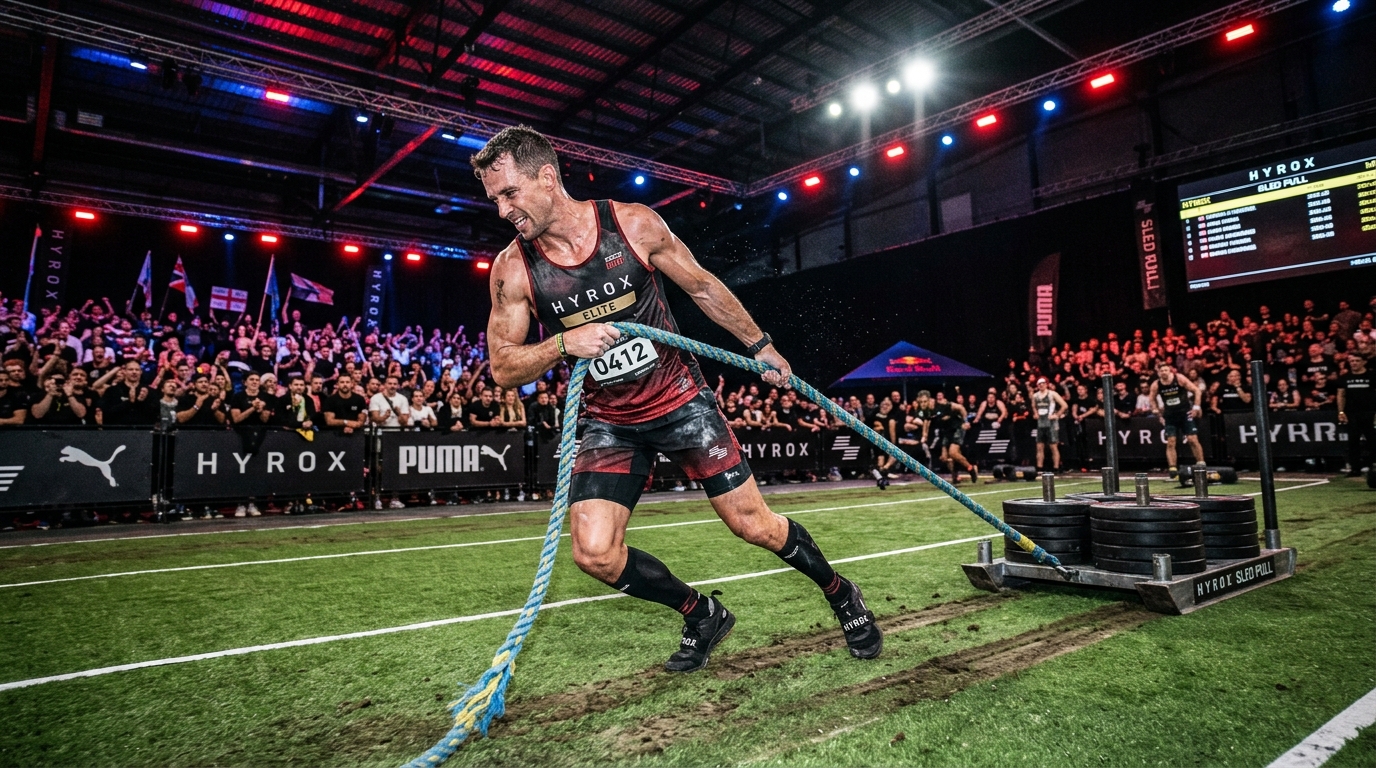
The correct pulling position: hips low, torso leaning back, rope over the shoulder or held with both hands at chest level, body weight as anchor.
Technique 1: Arm-Over-Arm (within the pulling square)
The athlete remains within the square marked on the ground, pulls the rope with one arm, releases, grabs more rope with the other arm and repeats. It is the most intuitive technique and the one that is taught first in most pits when they start working on the HYROX preparation.
Advantages: Greater speed in the first 3-4 meters (especially if the athlete has strong arms), does not require coordination of steps, easy to learn.
Disadvantages: It destroys the forearms and grip disproportionately. At 25 total meters into the station, most athletes already have completely fatigued carpal flexors, which will severely limit their ability to perform Wall Balls, Rowing, or any grappling exercises that follow. HR rises between 15-25 bpm above running HR for the same work pace, which compromises recovery between seasons.
Technique 2: Backward Step (walking backwards with rope on shoulders)
The athlete places the rope over his dominant shoulder (or holds it with both hands at the level of the sternum), leans the trunk forward at about 40-50°, and walks backward with short, powerful steps using the entire posterior chain: glutes, hamstrings, spinal erectors.
Advantages: The effort is distributed among the largest muscles in the body, with a much greater glycolytic reserve. Grip fatigue is minimal. HR increases only 8-12 bpm over running HR. Athletes with heavier body weight and good hip mobility have a clear mechanical advantage with this technique.
Disadvantages: It requires practice to coordinate the pace of steps with the direction of the pull. Walking backwards has a proprioceptive component that can be disorienting under extreme fatigue.
| Analysis Variable | Arm-Over-Arm | Backward Step |
|---|---|---|
| Main Muscles | Biceps, Forearms, Trapezius | Glutes, Hamstrings, Erectors |
| Average HR over running baseline | +18-25ppm | +8-13ppm |
| Post-Season Grip Fatigue (1-10) | 7-8/10 | 2-3/10 |
| Speed in first 4m | Elderly | Minor |
| Speed in last 8m | Minor (arm fatigue) | Major (consistent) |
| Total time 4×12.5m (Open Men) | 2:45-3:10 min | 2:30-2:55 min |
| Ideal for athletes <70kg | Yes (best ratio) | less efficient |
| Ideal for athletes >75kg | More wear | Yes (better use of mass) |
Footwear is probably the most undervalued equipment variable at HYROX. The difference in Sled Pull and Sled Push station time between inadequate and optimal footwear can be 15-30 seconds in intermediate level athletes, which is a huge difference in a race where qualifying is decided by seconds.
Technical Characteristics that the Optimal Footwear for HYROX Should Have
Sole Hardness (Shore A): The Shore A scale measures the hardness of the sole elastomer. For Sled Pull and Sled Push on carpet, you need a compound with a Shore A hardness between 62 and 70. Below 58, the sole compresses laterally during the push-off phase and you lose force transfer. Above 72, the sole does not adapt to the micro-irregularities of the carpet and loses grip.
Drop Heel-Toe: Maximum 8mm. Long-range running shoes with 10-12mm drops create an ankle angle that reduces your efficiency in the back push and can force excessive compensatory dorsiflexion in the knee.
Grip Pattern: Multidirectional, with channels that go in different directions. Exclusively linear patterns (like some running models) have good grip in the longitudinal axis but fail in lateral movements, which are frequent in the Sled Pull when the sled is not perfectly aligned.
Lateral Forefoot Structure: Reinforced support on the internal surfaces to resist pronation/supination forces during the Farmers Carry, Lunges and changes of direction during the 8km race.
The Dilemma of Unique Footwear vs. Specialized Footwear
The common trap is to search for "the perfect HYROX sneaker." It doesn't exist. HYROX combines running (8km), lifting (SkiErg, Sled), ground work (Burpee Broad Jumps, Wall Balls) and dragging (Sled Push/Pull, Farmer's Carry). Each discipline has different and contradictory footwear requirements.
The most practical solution for competitive level athletes: a cross-trainer shoe with intermediate drop (4-8mm), dense rubber sole and stable construction. Some elite athletes wear 8km-specific running shoes and change them for cross-trainers just before the sled stations, gaining 20-40 seconds at those stations.
To prepare for the Sled Pull without access to a dedicated sled, you can simulate muscle fatigue and cardiac profile with this substitution protocol:
- 6 rounds of: 15m of Hip Thrust with resistance band + 20m of Backward Walking with backpack loaded at 30% of body weight
- Rest 90 seconds between rounds
- Set the EMOM timer to TITAN RX with audible alarm at the end of each round and voice coach for counting
- Adjust your backpack load as you progress in the weeks leading up to the competition.
The Sled Pull is not just the Sled Pull. It is the Sled Pull after 5km of running and two previous stations. And before the SkiErg and Burpee Broad Jumps that come after. Managing the 8 stations as an integrated system is what separates competitive athletes from those who simply "finish the race."
Principle of Fatigue Distribution by Muscle Groups
The 8 HYROX stations predominantly use these muscle groups:
- Posterior Chain (Glutes, Hamstrings, Erectors): SkiErg, Sled Push, Sled Pull, Rowing
- Quadriceps and Hip: Sled Push, Burpee Broad Jumps, Wall Balls, Lunges
- Traction of Arms and Forearms: Sled Pull (Arm-Over-Arm), Rowing, Farmer's Carry
- Pushing/Push: SkiErg, Burpee Broad Jumps, Wall Balls
If you use Arm-Over-Arm in the Sled Pull and your next station is Rowing (also very demanding on the back and forearms), you will have severely compromised Rowing performance. If you instead use Backward Step in the Sled Pull, you will arrive at the Rowing with relatively fresh arms.