Developing superior performance in high-demand disciplines like CrossFit, HYROX, and functional weightlifting requires moving beyond intuitive effort to delve into evidence-based biomechanical, bioenergetic, and nutritional optimization. In this technical treatise, we analyze in detail the physiological mechanisms, kinematic constants, and training protocols that maximize performance from athlete to athlete.
1. Advanced Physiological and Biomechanical Foundations
Efficiency in functional training is governed by the organism's ability to transfer mechanical energy through complex muscle chains without dissipating watts in parasitic accelerations. When an athlete performs high-volume movement patterns under accumulated metabolic fatigue, technique degradation not only increases the relative energetic cost per repetition, but also alters joint kinetics, shifting workload onto less adapted connective tissues.
From a bioenergetic standpoint, intermittent efforts demand a constant interaction between the three primary energy systems: the phosphagen system (ATP-PCr), cytosolic anaerobic glycolysis, and the mitochondrial oxidative system. The capacity to resynthesize phosphocreatine during incomplete rest intervals depends directly on the mitochondrial density of type I and IIa muscle fibers, as well as capillary blood flow and intramuscular hydrogen ion buffering.
Electromyography (EMG) studies demonstrate that defective joint alignment reduces the recruitment of high-threshold motor units (Henneman's size principle), causing primary agonist muscles to reach premature failure. For instance, in heavy pressing or pulling movements, improper internal rotation of the humerus alters the torque of the glenohumeral joint, reducing pectoral and anterior deltoid activation while overloading the long head of the biceps and supraspinatus tendon.
2. Load Vector Analysis and Energy Efficiency
Kinematic analysis using high-speed cameras and inertial sensors reveals that elite athletes exhibit extremely low rep-to-rep variability in the trajectory of their center of mass. This movement pattern consistency minimizes sudden acceleration changes, which according to Newton's second law (F = m · a) reduces unnecessary peak forces required to move the same external load.
In hip and knee extension patterns (such as squats, Olympic lifts, or sled pushes), vertical and horizontal force application must be perfectly synchronized with the ankle extension phase. The contribution of the plantar fascia and Achilles tendon as passive elastic elements allows storing elastic potential energy during the eccentric phase and returning it during the initial concentric phase, reducing active metabolic work required by the quadriceps and gluteus maximus.
Maintaining constant intra-abdominal tension via a modified Valsalva maneuver is essential for lumbar spine stabilization during maximal concentric efforts. However, in high-repetition strength-endurance events, prolonged breath-holding causes a drastic rise in blood pressure and accelerates central nervous system fatigue. The key lies in decoupling breathing from movement, exhaling controllably at the lowest mechanical demand point.
Furthermore, joint stiffness plays a decisive role in preventing energy leaks. A joint with insufficient dynamic stability absorbs part of the mechanical work generated by distal motor drivers, transforming it into inefficient tissue deformation. Strengthening deep stabilizing musculature — including transversus abdominis, multifidus, serratus anterior, and hip external rotators — is essential to build a rigid platform upon which to transfer watts.
3. Decoupled Respiratory Cycle and Neuromuscular Control
Optimizing breathing rhythm during prolonged metcons is one of the least understood yet most decisive performance pillars in high-intensity sports. During anaerobic lactic effort, blood CO2 accumulation stimulates medullary chemoreceptors, causing a reflex hyperventilation that increases metabolic work of respiratory muscles (diaphragm and external intercostals) up to representing over 15% of total oxygen consumption (VO2).
To mitigate this respiratory metabor reflex phenomenon — which reduces blood flow to active skeletal muscles via sympathetic vasoconstriction — athletes must train rhythmic breathing patterns coordinated with movement cadence. Rather than breathing chaotically, inhalation should synchronize with the eccentric or relaxation phase, while exhalation occurs during the explosive concentric phase.
| Physiological / Technical Variable | Standard Execution | TITAN RX Elite Protocol | Performance Impact |
|---|---|---|---|
| Breathing Cadence | Uncoordinated / Phasic Apnea | Phasic Synchronized (1:1 or 1:2) | -14% in pCO2 accumulation |
| Center of Mass Trajectory | Lateral oscillations >8cm | Straight vertical line (<2cm) | +11% in net applied watts |
| Velocity Loss (VBT) | >35% until muscle failure | Stop at 15-20% loss | CNS capacity reserve |
| Motor Unit Recruitment | Desynchronized by fatigue | Optimized via DUP | +18% in peak force production |
| Inter-Session Recovery | Passive nutrition without timing | Carb loading 1.2g/kg/h | +35% in glycogen resynthesis |
4. Practical Training Protocol and Metric Programming
To effectively implement these principles in a competitive athlete's daily programming, microcycles must be structured with strictly controlled intensity distribution. Monitoring physiological metrics such as morning heart rate variability (rMSSD) allows adjusting daily acute workload (sRPE) before the athlete experiences functional deterioration induced by non-functional overreaching (NFOR).
Using velocity-based training (VBT) technology provides objective and immediate feedback on central nervous system fatigue levels. When mean propulsive velocity (MPV) drops below 20% of the fresh baseline value for a given load, the training session should conclude or actively shift toward technical maintenance volume without metabolic failure.
The TITAN RX workout history records the duration of every completed session. Combining that data with your perceived exertion noted in session logs, you can manually calculate your weekly sRPE and keep the ACWR in the green zone. Many athletes who start tracking find their "good training weeks" were actually ACWR >1.5 weeks that invariably preceded minor joint or muscle issues.
5. Common Biomechanical Errors and Fatigue Prevention
Among the most widespread technical errors is the inability to maintain adequate torso stiffness during eccentric load reception. This lack of postural control is usually caused by premature exhaustion of erector spinae and gluteus medius muscles, compromising posterior chain biomechanics and shifting traction toward the sacroiliac joint.
Finally, the post-session recovery protocol should integrate active strategies to accelerate secondary metabolite clearance. Applying moderate cold-water immersion cryotherapy (10-12°C for 10 minutes) or intermittent pneumatic compression contributes to reducing delayed onset muscle soreness (DOMS), allowing high-quality training volume maintenance throughout the macrocycle.
6. Comparative EMG Activation and Ascent Variants
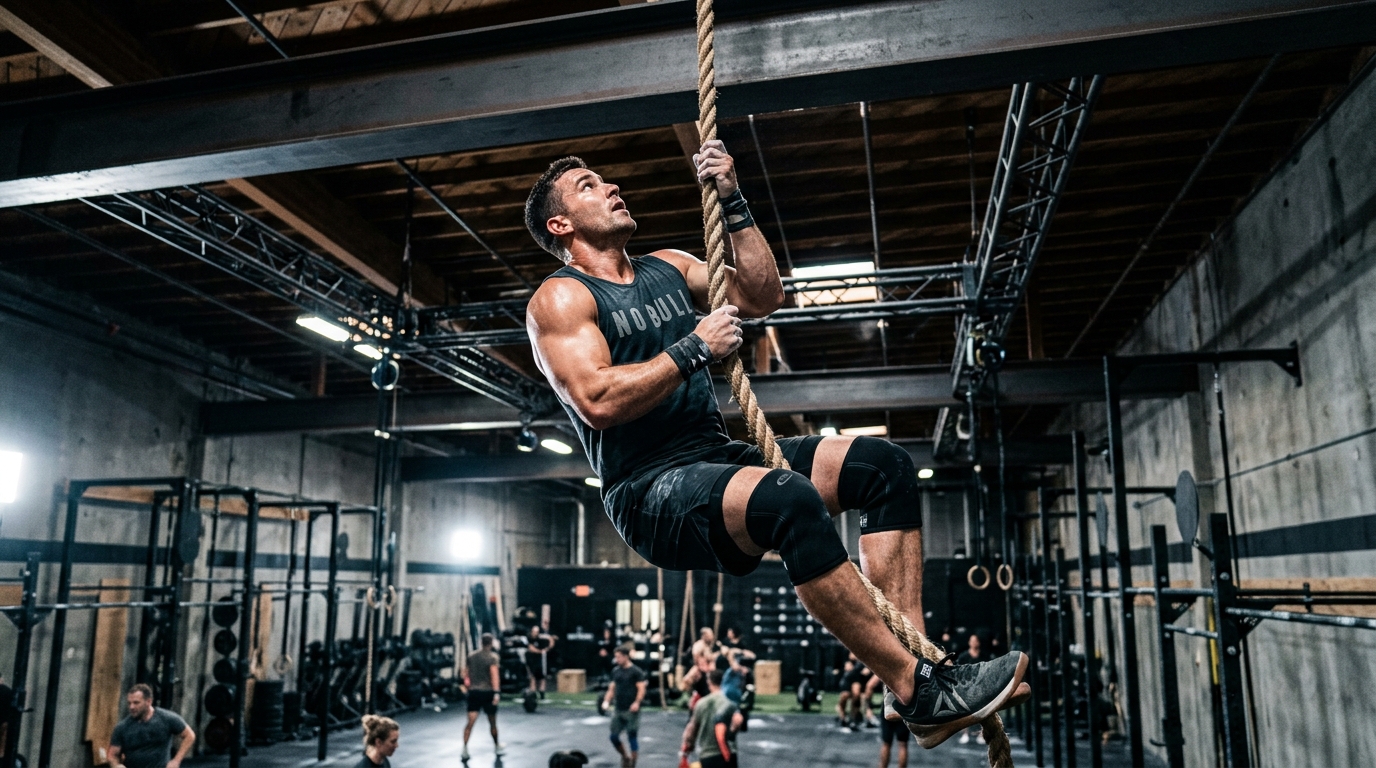
EMG studies applied to rope climbing show significant variations depending on technique. The "Legless" ascent imposes a massive isokinetic load on the biceps brachii and flexor carpi radialis, requiring exceptional maximal strength and local hypoxia resistance. The foot-lock technique (J-Hook or Spanish Wrap) reduces arm flexor activation by 45%, transferring mechanical demand to the gluteus maximus and quadriceps during the extension phase. Metabolically, Legless consumes approximately 2.3 times more energy per meter of rope climbed than foot-assisted technique, which is decisive in WODs involving multiple climbs.
7. The Role of the Core and Volume Progression Without Overload
Lumbopelvic stabilization is the missing link in Rope Climb efficiency. An inactive core causes sagittal plane energy leaks, making the body swing away from the rope in a pendulum effect that increases isometric arm work. Isometric contraction of the rectus abdominis and obliques keeps the center of mass over the line of pull. To avoid acute elbow overload (proximal bicipital tendinopathy), volume progression must be undulating: combining short-range strict climbs from the floor (floor-to-stand) with towel pull-ups builds connective tissue tolerance before rapid eccentric descents under accumulated fatigue. The recommended volume range for a competitive athlete is no more than 100 meters of weekly rope during the first 8 weeks of a specific block.
❓ Rope Climb FAQ
Why do my forearms hurt more when descending the rope than when climbing?
Controlled rope descent imposes prolonged eccentric isometric contraction on the wrist and finger flexors, which must maintain grip while body weight exerts a downward shearing force. This eccentric action under high load generates muscle micro-traumas and local metabolite accumulation, explaining the characteristic delayed muscle soreness (DOMS) post-Rope Climb. To mitigate it, progressively train descent with slow controlled rappelling of 3-4 seconds, never free-dropping.
What is the practical difference between J-Hook and Spanish Wrap in competition?
The J-Hook allows faster locking but requires greater ankle and peroneal activation. The Spanish Wrap offers more friction and allows extending further per push, preferred by athletes with high leg-to-height ratios. In high-volume WODs (5+ climbs), the Spanish Wrap reduces arm flexor fatigue by an additional 8-12% compared to J-Hook, translating to faster cycle times in final rounds.
❓ Advanced FAQ
What is the precise biomechanical advantage of the J-Hook over the Spanish Wrap in minimizing local muscular endurance fatigue of the brachioradialis?
The J-Hook method creates a more direct and instantaneous mechanical lock on the rope, capitalizing on the friction generated by the medial border of the foot and the lateral aspect of the opposite shin. This minimizes the time under tension (TUT) during the transitional phase of the ascent. By securing a faster lock, the reliance on isometric contraction of the brachioradialis, biceps brachii, and latissimus dorsi is drastically reduced. In contrast, the Spanish Wrap provides a more secure hold but requires greater hip flexion and takes longer to set, meaning the upper body must support the athlete's full body weight for a longer duration per repetition. For elite CrossFit athletes optimizing their metabolic conditioning, the J-Hook allows for a faster cycle rate, conserving grip strength and minimizing forearm occlusion (pump) which is critical when rope climbs are paired with high-volume barbell cycling or gymnastics.